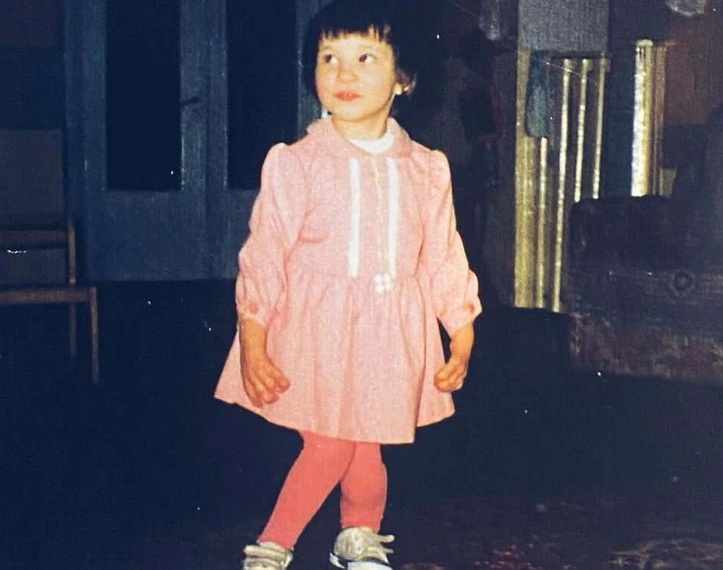
Oksana Masters spent her early years in an orphanage, and let’s just say those were not the greatest ones. Her birth family abandoned her because she had serious impairments. Oksana, who was born in 1989, has endured numerous challenges since birth.
Life was difficult, and after being moved between three orphanages, everything changed when she was adopted by Gay Masters, a single woman from the United States. Oksana has been surrounded by love and support ever since, and she has accomplished so much!
Oksana doesn’t have happy memories about her early childhood, all due to many struggles she had to endure as a child.

Oksana, who was born in 1989, recalls her early childhood as being constantly moved between orphanages. She was born with one kidney, half a stomach, six toes per foot, webbed fingers, and no thumbs. In addition, she had no shinbones in either leg, and her left leg was six inches shorter than her right.
Her original family gave her up for adoption, and she spent time in three separate orphanages until being adopted at the age of seven by Gay Masters, a single woman from the United States. It was a difficult two years, but Gay eventually brought Oksana home to begin a new chapter in her life.
Gay Masters became more than a mother for an abandoned and ill child, she became her guardian angel.

Friends attempted to persuade her otherwise. They advised her not to adopt an older child, particularly one with so many medical issues. But Gay, a speech pathologist at the University of Louisville, refused to be told what to do and instead followed her heart.
Oksana and her adoptive mother developed an instant bond straight away. They both knew they wanted to be a family, and it felt like they were intended to meet each other.

Gay said that the orphanage had given tiny Oksana a photo of herself and informed her that one day, this adult will come to take her home. Gay spent two years going through all of the adoption papers while Oksana waited patiently, hoping of the day her mother would finally come for her. “If I did something wrong, (the orphanage) would tell me the American woman didn’t want a bad child, and she wasn’t coming,” Oksana said.
But Gay came back. Gay knelt next to the 7-year-old as she slept in her orphanage bed two years after Oksana first learned about the woman who wanted to be her mother.
Oksana laughs as she recalls how different her early days with Gay in America were. “Oh yeah, my mom and I were very different; she loves books, and I loved climbing trees.”
Oksana and her mother overcame many difficulties together, and it made their bond even stronger.

Oksana was swift and nimble, so learning to walk and run with prosthesis came more easily to her. In America, she endured many reconstructive surgery to improve her hand function.
Gay, understanding how much movement benefited Oksana, decided to expose her to sports. “I had figured out by that point that sports were a kind of therapy for her, and I signed her up for a horseback riding lesson,” Gay told me. “I told her it was a state law in Kentucky that everyone learned how to ride a horse.”
Sports became Oksana’s escape and rehabilitation. “I didn’t like the idea of a sport that was geared towards people with disabilities,” she told me. “I wanted to feel like everyone else.”
Oksana’s way to success was thorhy, but her mom was always there for her.

Oksana’s left leg was amputated when she was nine years old, and her right leg five years after that. The woman recalls, “In middle school, someone informed me about the adapted rowing club, and I despised the notion that it was adaptive, and I didn’t want to participate at all. I liked the notion of sports, but I didn’t like being told I had to participate in an adaptive activity because I was only on one leg at the moment.
But Gay supported her daughter in every way possible, and she believed in Oksana from the moment she met her.
Oksana stated, “Finally, my mother said, ‘Just go for it. The moment I got in the water and pulled away from the pier, I had the impression that I was in the right location at the right time. I enjoyed pulling the oars and feeling the release afterwards… Of course, I wanted to push myself to the limit.
The young woman had great success in sports, and she believes her mother’s love and care helped her.

Oksana was hospitalized for approximately five months due to complications from her second amputation. “I couldn’t get out of bed, and all I wanted was to get back on the water,” she told me. “I just kept thinking that once I got out of here, I’d never stop moving. I will never sit in one location like this again.”
Oksana jumped back onto a boat as soon as she could, craving the freedom of being on the ocean. That was her happy spot. Then, someone casually mentioned the Paralympics to her, and it changed everything.
“And I had no idea what the Paralympics was,” she explains. “When I found out about it, I went home and looked it up, and my competitive side came out. “Oh my gosh, I can represent the United States?” Can I wear a flag on my back? What?'”
The young woman came a long way from a novice to Olympian.

Oksana continued rowing throughout her four years at Atherton High School, dedicating her heart to the sport. That passion took her all the way to the 2012 Paralympics in London, where she competed alongside fellow double-amputee athlete Rob Jones. They earned a bronze medal in the trunk and arms mixed double sculls competition.
But Oksana wasn’t finished yet. After the summer games ended, she focused on the Winter Paralympics. She began skiing immediately after London, taking on a completely new task. With just over a year to learn and practice, she competed in cross-country skiing and biathlon at the 2014 Paralympic Winter Games, earning silver and bronze medals.
For most athletes, mastering even one Olympic sport is sufficient. But Oksana is not like most athletes; she is a unique talent who has won medals in both the Winter and Summer Games. An incredible legend!
Oksana’s life has changed dramatically, but her love and gratitude for her mother has remained constant and has grown over the years.

Oksana Masters is 35 years old, and her athletic achievements are extremely extraordinary. She made history at the 2012 Summer Paralympics in London, capturing the first-ever medal for the United States in the trunk and arms mixed double sculls. She then joined the United States Nordic skiing team for the 2014 and 2018 Winter Paralympics, winning two medals in 2014 and five in 2018, including two golds.
Following the 2012 Paralympics, Oksana switched gears—literally—and began para-cycling. She went on to compete in both the 2016 and 2020 Summer Paralympics, winning two gold medals in the latter. She wasn’t finished yet, though. At the 2022 Winter Paralympics, she won another gold medal in the Biathlon – Women’s 6 kilometers, seated. Oksana received the prestigious Laureus World Sportsperson of the Year with a Disability title in 2020, establishing her reputation as one of her generation’s best athletes.
After addressing directly to her mother, Oksana turned to the camera and concluded her speech with three powerful remarks while holding one of her prizes. These words would make any parent proud, especially a mother who saw beauty and fortitude in the eyes and spirit of a small girl with delicate legs and deformed fingers in a black-and-white photo from more than 20 years ago.
“To any girl or boy, if you look different or think you look different, never let society decide what you see when you look in the mirror,” Oksana lectured the audience. “Never allow them to dictate what is feasible. “Go for it.”


