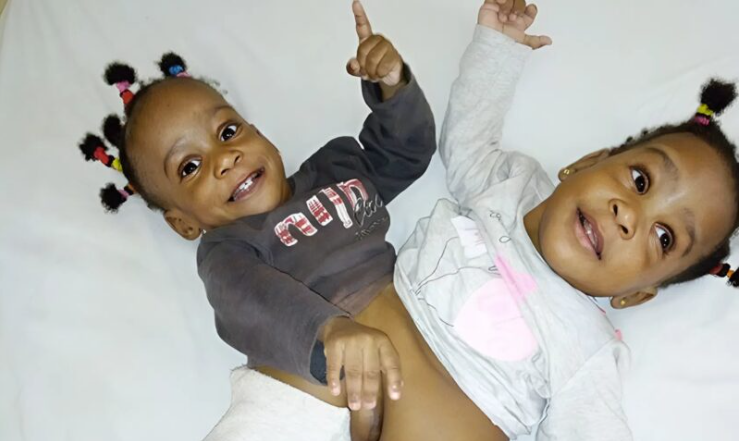
Siamese twins Bissi and Eyenga were born on November 6, 2018. They are conjoined at the belly. 😱
Their birth was difficult, a caesarean section was performed in a primitive clinic with only one nurse available for emergency deliveries.
As soon as they uttered their first cry, Laurel, their mother, felt an overwhelming sense of relief. However, upon seeing her daughters, so tiny and joined at the waist, her joy turned to fear. “At first, I was so afraid, I cried all the time, I didn’t dare touch them… I was alone, I needed comfort.”
The two sisters were joined at the waist, a rare anomaly Laurel was unaware of. Although she has a twin brother, she didn’t expect to give birth to conjoined twins. A mother’s love quickly overcame her fear. Laurel learned to carry them and cuddle them, often laying them on their sides, which explains why, at one year old, they still couldn’t stand. “They fought, scratched, and sometimes bit,” Laurel recounts with obvious tenderness.
However, in the village, things were different. Laurel was rejected, accused of carrying abnormal children. Her husband abandoned her, and only her uncle supported her, helping her get his daughters admitted to the gynecological maternity ward in Yaoundé. This was the beginning of a long medical journey that would lead to surgery in France.
They faced several difficulties, but the operation was successful. 😱😱

Chain of Hope, a charity, helped fund their trip to Lyon, where the sisters were welcomed.
Their difficulties didn’t end with their arrival in France. Bissi, the weakest of the sisters, was diagnosed with cardiopathy and had to undergo heart surgery after the sisters were separated.
But at that moment, they demonstrated strong solidarity. Eyenga, seeing her sister receiving medical care, became an advocate, even shielding her sister from medical examinations.

The operation was successful, and both sisters began a new chapter in their lives, though the separation was a shock. Previously inseparable, they slowly adapted to their separation, learning to live more independently.
Bissi, though still weak, is starting to smile, and both girls are now eating everything, nourished by purees prepared by Aurora, the volunteer who adopted them.

As part of their recovery, Laurel is considering getting her daughters’ names tattooed on her body, a symbolic gesture to banish the shame and rejection she faced in her home country.
She wants this tattoo to be a reminder of the love and support she has received and the hope she has for her daughters’ future.


