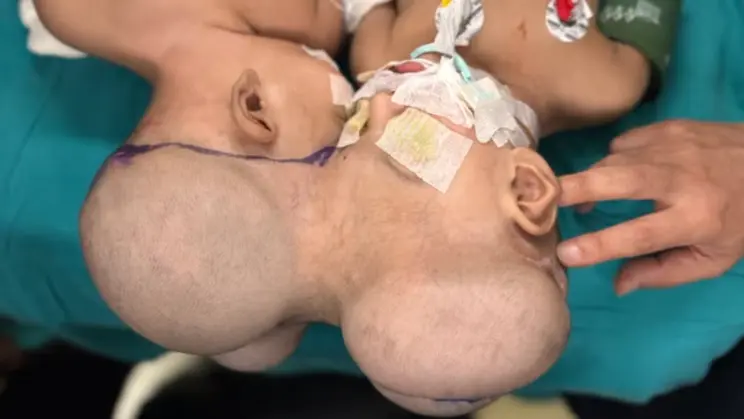
Surgeons are celebrating a remarkable medical achievement after separating twin girls who were conjoined at the head.
Minal and Mirha, born in Pakistan last year, shared crucial blood vessels and sections of brain tissue—making any separation procedure extremely risky. Despite the dangers, UK neurosurgeon Professor Noor ul Owase Jeelani and his team at Ankara Bilkent City Hospital in Turkey carried out a challenging 14-hour operation on July 19.

Two months later, the twins are recovering well and are almost ready to return home.
“They’re doing incredibly well—really wonderful,” Professor Jeelani told Sky News. “They should be able to go back to Pakistan within a few weeks.”
The surgical team relied on advanced Mixed Reality (MR) technology, which overlays 3D images onto the real world, to plan and execute the procedure. This allowed them to create an accurate 3D model of the girls’ heads and rehearse the surgery in detail before the actual operation.

“The technology we’ve developed for cases like this makes even routine surgeries safer, less invasive, and more effective,” Jeelani explained.

Before the main 14-hour separation, the team performed a smaller preliminary surgery on July 14 to prepare the twins.

“To give these girls and their family a future where they can grow up independently and enjoy their childhood is a tremendous privilege,” Jeelani said.


This isn’t Professor Jeelani’s first groundbreaking surgery. In 2022, he led a 27-hour operation to separate three-year-old Brazilian twins Bernardo and Arthur Lima, who were also joined at the head. That procedure involved more than 100 medics working from two different countries using virtual reality headsets to coordinate in real time.

As Jeelani noted at the time, “It’s incredible to be able to study the anatomy and practice the procedure before the children are ever at risk—it gives surgeons enormous confidence.”


